How the DEX works
Technically there are two main components.
- The order book - Contains all the signed orders (the NFTs which can be sold). The order book is off-chain.
- The DEX smart contract - Exchanges the assets in a single transaction.
NFT Owner sells his NFT

The order book contains all the signed orders from the sellers (aka makers). Whenever someone wants to sell an NFT, the seller defines a fix price and the currency to pay with. After the seller creates a digital signature with his crypto wallet. This signed order will then be stored in the order book.
The buyer (aka taker) will select the signed order and submit this order to the DEX smart contract. The DEX smart contracts will validate the order (signature, price match, and so on). If the order and signature is valid the DEX smart contract will exchange the assets in a decentralized way in a single transaction.
Transaction analysis
All the following examples are based on the following definition in the table below.
| Description | Address |
|---|---|
| Dex Address | 0x6a85796b158729474150d1c94a66184368d52142 |
| Dex Operator | 0x7c368f7d21503a1857c1b885470b330f5d26c4b7 |
| WETH Address | 0xb4fbf271143f4fbf7b91a5ded31805e42b2208d6 |
| User1 - Seller | 0x92e56418297664a34a91f0e3a6a81aa092f268f1 |
| User2 - Buyer | 0x0291170dd80c24f2059ca0ad840f3d6573a7a46b |
Sell ERC721 NFT with ETH
User1 creates a sell order.
{
  "hash": "0x30ba20598b4e977f26465c25f7ba7bd6f4724924ae28cd3b81f67627ce323786",
  "sig": "0x3f89a18f83ca12b65c94394f50ff9c7107bee18d4d22c1f067a4558c6b51f0213b38e2791042fab700c75560295bf40236f66a4efb2e2428933613867977c6d71c",
  "order": {
    "maker": "0x92e56418297664a34a91f0e3a6a81aa092f268f1",
    "nftAddress": "0xec455e43adf3b073d9fef311205305ccf8e7574a",
    "nftTokenId": "8680783491275350067",
    "orderType": 0,
    "maxNbrOfNftsToTrade": "1",
    "erc20PaymentToken": "0x0000000000000000000000000000000000000000",
    "pricePerNft": "1000000000000000",
    "ttl": 1667329052257,
    "nonce": 4914140582696146000
  }
}
User2 fills the order.
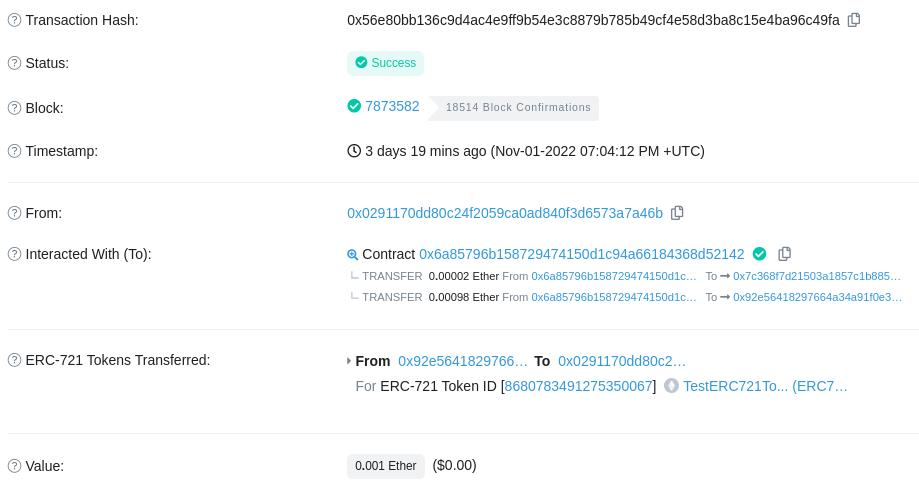 TX Hash: 0x56e80bb136c9d4ac4e9ff9b54e3c8879b785b49cf4e58d3ba8c15e4ba96c49fa
Sell ERC721 NFT with WETH
User1 creates a sell order.
{
  "hash": "0xfb997896b8bb7e5a43e9588037bb27a2b36e27a3033dcf9d659a3eee0a069cff",
  "sig": "0xfe3fb89ceb9e5ba82b9085b298f81cf8c15e13ef6a9b42326c225c2ded066a5137c9930044ae5831f507f74c1b096eb267ed33055ba895097f8bb0ee6d023a9d1b",
  "order": {
    "maker": "0x92e56418297664a34a91f0e3a6a81aa092f268f1",
    "nftAddress": "0xec455e43adf3b073d9fef311205305ccf8e7574a",
    "nftTokenId": "1773901249514399562",
    "orderType": 0,
    "maxNbrOfNftsToTrade": "1",
    "erc20PaymentToken": "0xb4fbf271143f4fbf7b91a5ded31805e42b2208d6",
    "pricePerNft": "1000000000000000",
    "ttl": 1667329561805,
    "nonce": 142845367006028510
  }
}
User2 fills the order.
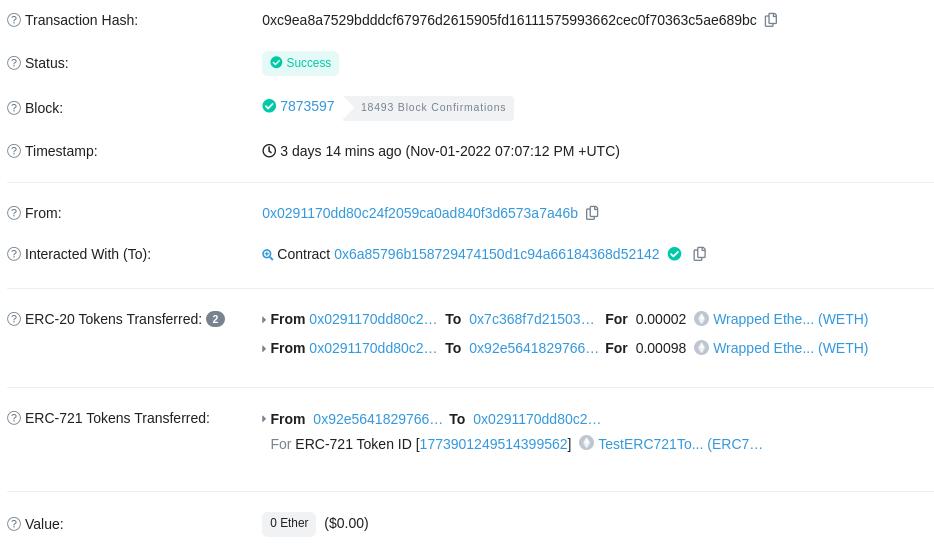 TX Hash: 0xc9ea8a7529bdddcf67976d2615905fd16111575993662cec0f70363c5ae689bc
Bid for ERC721 with WETH
User2 wants to buy the NFT but there is no sell order. Therefor the User2 creates a bid order
{
  "hash": "0xc0ed952de9a275d374dc0dc544b9b8f5fe1eca24ae6d6f62eb0e67361f5f53b2",
  "sig": "0x0b797e630d6a5c9c6e17c06c78b1bf28d1a6e40828e9b47543ebeb27432249d34d04ca4dccc19f92bf615cb0b7f72957ab7d994fb9d6b2cd91f3b1c0745e2d5d1c",
  "order": {
    "maker": "0x0291170dd80c24f2059ca0ad840f3d6573a7a46b",
    "nftAddress": "0xec455e43adf3b073d9fef311205305ccf8e7574a",
    "nftTokenId": "5240129628470187580",
    "orderType": 2,
    "maxNbrOfNftsToTrade": "1",
    "erc20PaymentToken": "0xb4fbf271143f4fbf7b91a5ded31805e42b2208d6",
    "pricePerNft": "1000000000000000",
    "ttl": 1667329785478,
    "nonce": 7758329145365391000
  }
}
User1 fills the order.
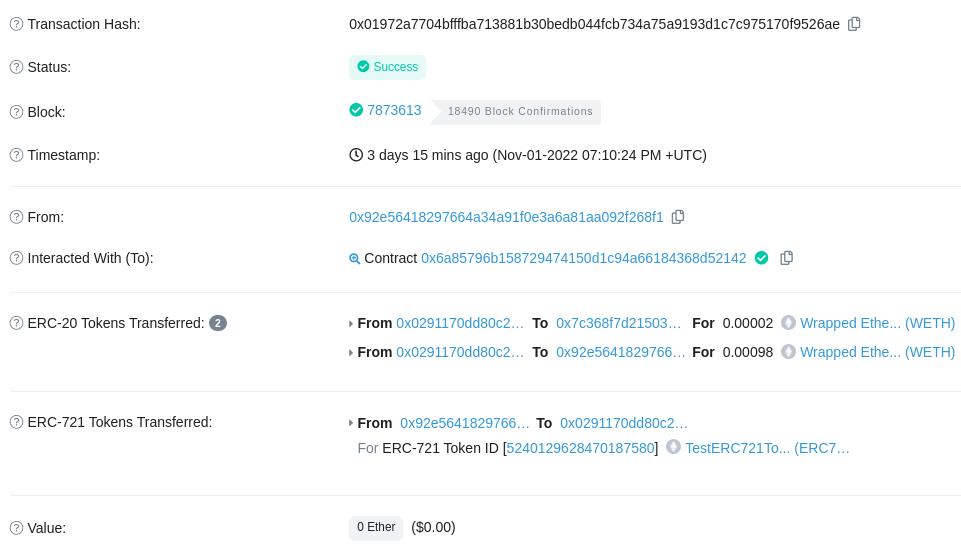 TX Hash: 0x01972a7704bfffba713881b30bedb044fcb734a75a9193d1c7c975170f9526ae
The difference here is that the NFT owner (User1) submits the transaction to the blockchain network.